


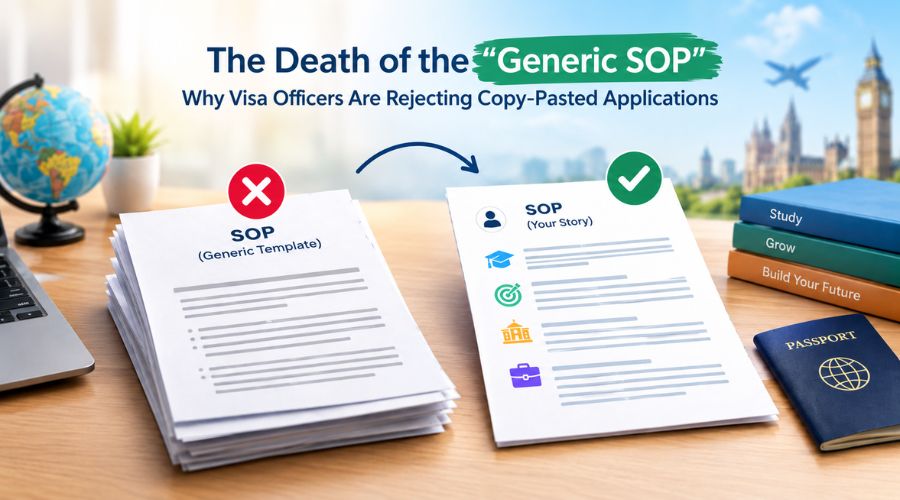
A strong Statement of Purpose is more than a formal document. It is an opportunity to explain your academic journey, your reasons for choosing a particular university, and how studying abroad fits into your future plans. Yet many applicants still submit nearly identical SOPs filled with impressive-sounding statements that reveal very little about their actual circumstances.
For international students, this approach can create serious problems.
A Statement of Purpose (SOP), study plan, or letter of explanation may help an immigration officer understand why an applicant wants to study in a particular country. However, when an application relies on generic paragraphs, unsupported claims, or information that contradicts other documents, it may fail to explain the applicant’s individual circumstances convincingly.
Using a template is not necessarily a problem. The real issue is failing to personalize it to your academic background, chosen course, financial situation, and career plans.
A generic SOP may leave important questions unanswered, especially when its claims do not match the supporting documents. A convincing application should be personal, consistent, and supported by credible evidence.
In this guide, we explore why generic SOPs can weaken student visa applications and how to write a more authentic, compelling statement.
What Is a Generic SOP?
A generic SOP is a statement that uses broad, repetitive language without adequately explaining an individual applicant’s reasons for studying a particular course at a particular institution.
Consider a common opening:
“I have always dreamed of receiving a quality education abroad. Your prestigious university offers excellent academic opportunities and a multicultural environment. I believe this program will help me achieve my career goals and contribute to my country’s development.”
There is nothing inherently wrong with these sentiments. Thousands of students genuinely want quality education, international exposure, and better career opportunities.
The difficulty is that this paragraph does not explain anything specific about the applicant.
It does not identify the academic experience that inspired the student’s decision, the course features that match their interests, the skills they need to develop, or the professional objective they intend to pursue.
A generic SOP often contains the following characteristics:
- Repeated phrases such as “world-class education,” “global exposure,” and “international career opportunities.”
- The same academic motivation regardless of the selected course or university.
- Vague claims about future success without a realistic career plan.
- Limited explanation of study gaps, academic changes, or previous qualifications.
- Financial explanations that do not correspond with the supporting documents.
- University descriptions copied from websites without explaining why they matter to the applicant.
- Career plans that sound ambitious but lack a clear connection to the chosen qualification.
A polished document is not necessarily a persuasive document. An applicant needs to demonstrate why the proposed study plan makes sense for their particular circumstances.
Why Can Copy-Pasted SOPs Be a Problem?
Visa officers assess applications according to the rules and requirements of the destination country. Depending on the application, they may consider the applicant’s study plans, personal circumstances, financial situation, and supporting documents.
A generic SOP can make it harder to understand the applicant’s actual intentions.
Here are three common problems.
1. Your Course Choice Lacks a Clear Explanation
Simply saying that a university is prestigious is not enough to explain why you selected its program.
You should understand what the course offers and how it connects to your previous education or future goals.
2. Your Career Plans Sound Too General
Statements such as “I want to become successful” or “I want to contribute to my country” sound positive, but they lack detail.
Explain what skills you hope to gain and how the qualification could support your career plans.
3. Your SOP Does Not Match Your Documents
Your statement should be consistent with your academic records, employment history, financial evidence, and application forms.
If there is a study gap, a change of subject, or another important circumstance, explain it honestly where relevant. Do not hide facts or invent experiences to make your application appear stronger.
What Makes an SOP More Convincing?
You do not need complicated English or dramatic storytelling to write a good SOP. Clear, honest explanations are more useful than impressive words without substance.
Focus on these four things:
Explain your background. Describe your previous studies, work experience, or interests and how they influenced your decision.
Choose your course carefully. Identify relevant subjects, specializations, or learning opportunities that match your goals.
Explain your university choice. Research the institution and explain why its actual program suits your needs.
Describe your future plans. Show how the qualification could help you move towards a realistic career goal.
For example, instead of writing, “I want to study data analytics because it offers great career opportunities,” explain how your previous business studies introduced you to data-based decision-making and why you now want to develop technical analytical skills.
That extra detail makes the reason behind your decision clearer.
Does Every Country Have the Same SOP Requirements?
No. Different countries have different application procedures and assessment criteria.
For example, Canada’s study permit guidance recommends a letter of explanation. Australia uses the Genuine Student requirement, while UK Student visa applications are assessed under their own rules, including relevant credibility considerations.
These processes are not identical, and not every destination requires the same type of SOP.
Before writing, check the current official visa requirements for your chosen country. Follow the specific questions, document instructions, and word limits that apply to your application.
Can You Use AI to Write Your SOP?
AI tools can help improve grammar, organise ideas, and make writing easier to understand. However, copying an AI-generated statement without checking it can create the same problems as using a generic template.
Your SOP should reflect your real experiences and intentions. Always verify university information, remove inaccurate claims, and make sure you understand everything in your statement.
There is no guarantee that either AI-written or human-written text will result in visa approval. What matters is the accuracy, relevance, and consistency of your application.
Checklist Before Submitting Your SOP
Before submitting your application, ask yourself:
- Have I explained why this course is right for me?
- Can I clearly explain why I chose this university and country?
- Do my career goals connect with the program?
- Is everything consistent with my supporting documents?
- Have I explained relevant gaps or unusual circumstances honestly?
- Can I confidently explain everything I have written?
If your SOP could be submitted by another student simply by changing a few names, it probably needs more personal detail.
Conclusion
Writing an SOP should not be about finding the perfect template or using impressive vocabulary. It should be about explaining your genuine reasons for studying abroad.
Templates can help you organise your ideas, and professional guidance can help you improve your application. But your statement must reflect your own academic journey, course choice, and future plans.
Do not write an SOP just to impress a visa officer. Write one that clearly explains your real intentions and supports the information in your application.
At Schooling Visa, we encourage students to research their study options carefully and prepare their applications with accurate information. Every student’s situation is different, so take the time to understand the requirements before applying.
Note: Visa requirements vary by country and individual circumstances. Always consult the latest official immigration guidance before submitting an application.