


UK Student Visa: 2024 Requirements and New Regulations.
New Rules for UK Study Visa in 2024: Faster and Easier Process
Studying in the UK is a dream for many international students, including Indians. However, the process of getting a student visa can be tricky and time-consuming.
To simplify things for Indian students heading to the UK for higher education, some changes are happening in 2024. These changes promise quicker processing times, simpler application procedures, and more options for Indian students eager to study in the UK.
This article breaks down the upcoming requirements for a UK Study Visa in 2024. Let’s dive in.
Top 7 UK Study Visa Requirements in 2024
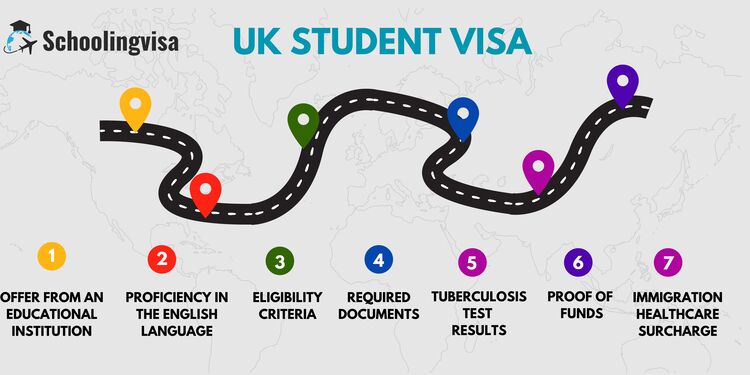
If you want to study in the UK and you’re not from there, you need to be at least 16 years old. You also have to get accepted by a well-known school or have a licensed sponsor. It’s crucial to show that you have enough money or someone to support you financially for your studies and living costs.
Lots of students from different countries choose the UK for education, and even with the pandemic, many students from Bangladesh have been getting their visas approved. To sum it up, if you’re applying for a UK student visa in 2024, make sure you’re over 16, have a good school or sponsor, and can cover your expenses.
| UK Student Route Visa Requirements | |
| General requirements |
|
English Language proficiency for visa (University requirements could be higher) |
|
| Financial requirements |
|
| Evidence of qualifications | Certificates or Official Transcripts Must Include:
|
| English Translations |
|
Offer from an Educational Institution
Offer from a Licensed Student Sponsor:
- Obtain a Confirmation of Acceptance for Studies (CAS) from the educational institution.
- Ensure you have the CAS before applying for a UK Student Visa.
- Apply for the visa within six months of receiving the CAS.
Course Options:
- Part-time course above degree level (RQF level 7 or higher) may require the Academic Technology Approval Scheme (ATAS) certificate.
- Full-time courses qualifying for degree level or higher (RQF level 6.7 or 8).
- Full-time courses qualifying for below degree level (RQF level 3.4 or 5).
- English language course at CEFR level B2 or higher.
- Approved foundation program sponsored for dentists and postgraduate doctors.
CEFR (Common European Framework of Reference for Languages):
- A standardized scale measuring language proficiency.
- Ranges from A1 (beginner) to C2 (proficient user).
- English language courses require a B2 level or higher on the CEFR scale for effective academic communication.
What is a CEFR?
- The CEFR is a guideline developed by the Council of Europe to standardize language proficiency levels.
- It aims to provide a common reference for language learners, teachers, employers, and educational institutions across Europe.
Proficiency Levels:
- The framework defines six main levels, divided into three broad categories:
- Basic User (A1, A2)
- Independent User (B1, B2)
- Proficient User (C1, C2)
Descriptors:
- Each level has descriptors outlining what learners can do in terms of speaking, listening, reading, and writing.
- These descriptors help assess and communicate language proficiency accurately.
Assessment and Applications:
- The CEFR is used in language education, curriculum development, and assessment.
- Many language proficiency tests, including the International English Language Testing System (IELTS), align with the CEFR levels.
English Language Courses and CEFR:
- English language courses, especially for visa purposes, often specify a required CEFR level.
- For example, a B2 level on the CEFR scale is considered upper-intermediate proficiency, indicating the ability to handle complex language tasks in academic settings.
Global Recognition:
- While developed in Europe, the CEFR has gained global recognition and is widely used beyond European borders.
- It provides a standardized way to communicate language proficiency, facilitating international language education and mobility.
Understanding and referencing the CEFR levels ensures consistency and clarity in describing language abilities across various contexts and languages.
Proficiency in the English Language
To study in the UK, you need to demonstrate proficiency in English, assessed on the CEFR (Common European Framework of Reference for Languages) scale.
Proof of English Proficiency:
- As evidence, you must pass the Secure English Language Test (SELT).
English Skill Levels (CEFR) for Different Levels of Study:
- Below degree level: B1
- Degree level or above: B2
Note for Degree Level or Higher:
- If applying for a degree-level course or higher, the educational provider may assess your English language skills.
- Alternative tests may be considered, but the results must be equivalent to the B2 level on the CEFR scale.
Eligibility Criteria

Age Requirement:
- The applicant should be at least 16 years old.
Financial Capability:
- The candidate must demonstrate the ability to cover the course fees and support themselves financially throughout their stay.
Offer from an Approved Institution:
- An offer of admission must be secured from an educational institution approved by the authorities.
English Language Proficiency:
- The applicant needs to achieve a specific proficiency level in the English language test results.
Documents Needed
Documents Required for Student Visa:
Personal Documents:
- Valid passport
- Completed visa application form
- Recent passport-sized photograph
Financial Documents:
- Proof of visa fee payment
- Financial evidence demonstrating funds availability
Educational Documents:
- Confirmation of Acceptance for Studies (CAS)
- Valid Academic Technology Approval Scheme (ATAS) certificate if specified
Health-related Documents:
- Medical test results for tuberculosis
- Payment receipt for Immigration Healthcare Surcharge (IHS)
Additional Documents for Under 18 Applicants:
- Proof of parental or legal guardian consent
- Evidence of the relationship with parents or legal guardian
- Copy of birth certificate or relevant government document displaying parent names
Sponsorship Details (if applicable):
- Written agreement from financial sponsor
Legal Clearance:
- Police clearance certificate
Note: Program-specific requirements, including the need for an ATAS certificate, will be mentioned in your offer letter.
Tuberculosis Test Results
Tuberculosis Examination Requirement:
- Mandatory for those planning to stay in the UK for over six months.
- Applies to visa applicants from specific countries as listed.
Examination Process:
- Involves a chest x-ray test for the initial examination.
- If results are uncertain, a sputum sample may be required.
Authorized Test Performers:
- Only approved clinicians are authorized to conduct these examinations.
Negative Results Certificate:
- A negative tuberculosis test result will result in the issuance of a certificate.
Certificate Validity:
- The certificate is valid for six months from the date of the test.
Proof of funds
Sufficient Funds for Living Expenses and Tuition Fees:
- To support your living expenses and pay tuition fees in the UK, a minimum of £1,265.00 is required.
Funds Required According to Confirmation of Acceptance for Studies (CAS):
- £1,015 per month for living costs if your course is outside London.
- £1,265 per month for living costs if your course is in London.
- £2,530 for a course in London (for those on the Doctorate Extension Scheme).
- £2,030 for a course outside London (for those on the Doctorate Extension Scheme).
Exception to Proof of Funds Requirement:
Proof of funds is not required if:
- You had a valid UK visa for a minimum of 12 months previously.
- Your country is listed under the ‘differential evidence requirement’.
- Your application designates you as a student union sabbatical officer.
Immigration Healthcare Surcharge (IHS)
The Immigration Healthcare Surcharge (IHS) is mandatory for those intending to stay in the UK for over six months.
Payment Calculation:
- The amount to be paid depends on the duration of your stay in the UK.
Payment Details:
- If granted leave for less than six months, you’re required to pay half of the annual IHS amount.
- If granted leave for more than six months, the full yearly IHS amount is applicable.
Healthcare Access:
- Once the IHS is paid, you gain access to the National Health Service (NHS) for medical services. However, certain services like dental treatments, prescriptions, assisted conception, eye tests, etc., still require separate payments.
Types of Student Visas in 2024
Study Visa Type | Who is eligible? | When to apply? | When to arrive in the UK? |
Student Visa It replaced the Tier 4 (General) student visa | For students aged 16 or above who are offered a course at a UK University or college Allows you to stay as per your course length Processing time: 3 weeks | 3 months before the course starts | 1 week before if your course lasts 6 months or fewer Up to 1 month before if your course lasts more than 6 months |
Child Student Visa It replaced the Tier 4 (Child) student visa | Students between 4 and 17 Processing time: 3 weeks | 3 months before the start of your course | Up to 1 week before if your course lasts 6 months or fewer Up to 1 month before if your course lasts more than 6 months |
Short-term Study Visa | Students in a short-term course (for 6 to 11 months) Processing time: 3 weeks | 3 months | Depends on travel dates |
Updates to UK Immigration Rules for International Students
End of Free Movement:
- Starting from January 1, 2022, the UK has replaced free movement with a new points-based immigration system.
New Points-Based Student Route:
- Implemented on October 5, 2020, the new Student route removes any cap on the number of international students coming to the UK.
Priority for Highly Skilled Individuals:
- The new immigration system prioritizes highly skilled individuals, especially those with scientific, academic, and technology-related qualifications.
Changes to Post-Study Work (PSW) Visa:
- Allows Ph.D. graduates to work and live in the UK for 3 years after completion.
- Master’s degree holders can stay and work for 2 years.
- PSW limit for Master’s degree holders can be extended from 2 to 4 years by the government.
Objective:
- The new rules aim to boost the total number of international students in the UK’s higher education system to 600,000 annually by 2030.
Positive Impact on Indian Students:
- The British Council highlights a positive impact on the number of Indian students choosing the UK for higher education.
Application Process:
- All migrants intending to work or study in the UK must apply for permission in advance.
FAQs
For Students from the EU, Norway, Switzerland, Liechtenstein, or Iceland:
- No visa is needed for entry before December 31, 2020.
- A visa is required for entry from January 1, 2022.
- For continued stay, apply for EU Settlement if settled before December 31, 2020; the application deadline is June 30, 2022.
Airport Arrival Procedure:
- Complete a contact tracing form at the airport before proceeding to customs.
Self-Isolation Requirement:
- Undergo a 14-day self-isolation period upon arrival.
BRP Application for Long-Term Courses:
- If your education course duration exceeds 6 months, apply for a Biometric Residence Permit (BRP) within one month of arrival.
UK Entry Flexibility for International Students:
- After visa issuance, entry to the UK is allowed within 30 days.
- Due to the pandemic, the Australian government has extended this limit to 90 days, offering increased flexibility for international students.
The UK government has decided that students who enter the UK before 6th April 2022 and have started their course are eligible to apply for Graduate Immigration Route and Post Study Work Benefit for 2 years.
The government has made it compulsory for students to get a tuberculosis test and submit their report and passport while applying for a UK student visa. On reaching the UK, students are required to go through 14 days of self-isolation.
Pre-course Arrival Requirement:
- Students are advised to arrive in the UK 14-17 days before the commencement of their course.
COVID-19 Flexibility:
- Due to the ongoing COVID-19 situation, the government allows Indian students and others to participate in online classes until they can physically join their UK university.
This flexibility aims to accommodate students affected by travel restrictions or other challenges related to the pandemic.
CAS (Confirmation of Acceptance for Studies):
Definition:
- CAS, or Confirmation of Acceptance for Studies, is an electronic document issued by the university where a student has been admitted.
Validity and Tier 4 Visa:
- The CAS is valid for six months from the date of issuance, specifically for Tier 4 visa applicants.
Unique Reference Number:
- The university assigns a unique reference number to the student’s CAS.
- This reference number is crucial and must be provided by the applicant when applying for a Tier 4 visa.
CAS documents include:
- 14-digit reference number for the CAS
- Sponsor License Number (SLN) of the university
- Beginning date and end date of your course
- Course Title
- Tuition fees
- Paid tuition fee details if you have already paid to the university
- Paid fees for accommodation if you have already paid
- English Language proficiency score
For International Students and Visa Holders in the UK:
BRP Requirement:
- International students and individuals on dependent, visitor, student visitor, or short-term study visas in the UK need a Biometric Residence Permit (BRP) if their stay exceeds 6 months.
BRP Collection for Students:
- Students must collect their BRP cards within 10 days of their arrival in the UK.
Why Choose Schooling Visa
SchoolingVisa Overseas Careers stands out as our consultant, and our track record speaks for itself. We’ve successfully served our customers.
Explore the World with schoolingvisa:
- Visit Visa: Whether for leisure or business, embark on global travel with schoolingvisa.
- Study Visa: Unlock opportunities to study in globally recognized universities.
- Work Visa: Settle in the world’s best cities and pursue your career ambitions.
- Immigration: Your comprehensive solution for all visa and immigration requirements.
- Permanent Residence: Attain the status of Permanent Resident and enjoy exclusive benefits.
Tailored Services for Your Success:
- Profile Evaluation: We analyze your unique profile history, aligning it with visa eligibility criteria, and provide guidance on the appropriate visas to pursue.
- Resume Writing: Craft a standout resume tailored to meet the expectations of immigration authorities.
- Document Procurement: Assist in gathering essential documents required for visa applications.
- Professional Guidance: From interview training to language courses and crafting impactful resumes and cover letters, we offer comprehensive support.
- Dedicated Case Officer: Enjoy personalized assistance and a singular point of contact throughout the entire process.
- Post-Landing Services: Our support extends beyond visa approval, helping you settle comfortably in your new country with customized post-landing services.
Experience a seamless journey for all your visa needs with Schoolingvisa – from profile evaluation and document preparation to post-visa settlement services. If you have questions about filing the AIPP application, reach out to us immediately. We are here to assist you in every possible way.
Take the first step – start your visa application today!