


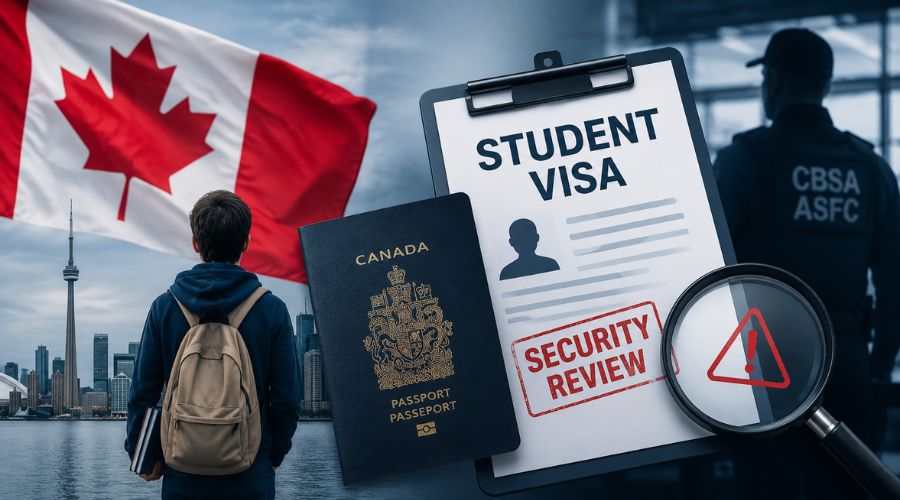
Canada’s international student program is facing renewed scrutiny after reporting on a classified Canada Border Services Agency (CBSA) intelligence assessment revealed a dramatic increase in criminal charges involving some Indian nationals who entered Canada on study permits.
The report has also triggered strong political criticism from Conservative MP Michelle Rempel Garner, who has raised concerns about organized crime, immigration enforcement and the treatment of non-citizens convicted of serious offences.
For prospective international students, however, the issue needs to be understood carefully. The findings concern a subset of study-permit holders and should not be interpreted as suggesting that international students generally are involved in criminal activity.
What Does the CBSA Report Say?
According to reporting by Global News on a classified CBSA intelligence document concerning the Bishnoi gang, criminal charges involving Indian study-permit holders increased by 8,800% between 2016 and 2024.
The CBSA assessment reportedly identified India as the leading source country among foreign students charged with crimes.
Between 2019 and 2023, approximately 4,000 Indian citizens who had entered Canada on study permits were charged with 17,929 offences. The report said about 4,920 of those charges were considered serious or organized-crime related, with 97% of those offences categorized as violent.
The report also stated that in 2024, more than 13,040 criminal charges were laid against Indian citizens in Canada who were on study visas. Global News reported that 2,418 people were represented in those 2024 figures.
These numbers have attracted significant attention because of concerns that organized criminal groups may have exploited Canada’s international student system.
Concerns About Organized Crime and Student Visas
The CBSA intelligence assessment reportedly focused on the expansion of India’s Bishnoi gang in Canada.
According to the report, investigators increasingly identified Indian foreign nationals holding study and work permits among people involved in organized criminal activities connected to the gang.
One example highlighted in the reporting involved Goldy Brar, a senior Bishnoi associate who entered Canada in 2017 on a student visa. The CBSA assessment reportedly described how the gang subsequently recruited young people in Canada to participate in criminal activities.
The report does not establish that Canada’s international student population as a whole is connected to organized crime. Rather, it identifies specific cases and trends that Canadian authorities believe warrant greater scrutiny.
That distinction is important for students, parents and education advisers.
Michelle Rempel Garner Calls for Stronger Action
The CBSA findings have prompted Conservative MP Michelle Rempel Garner to call for stronger action against serious crimes committed by non-citizens.
In August 2026, Rempel Garner publicly criticized what she described as overly lenient sentences for some non-citizens convicted of violent offences and argued that Canada’s immigration and criminal justice systems need stronger enforcement mechanisms. Global News reported her comments following the publication of its investigation into the CBSA assessment.
She has also previously supported legislative changes aimed at preventing immigration status from influencing sentencing decisions in ways that could potentially affect deportation outcomes.
However, there is an important legal nuance.
Can Immigration Consequences Be Considered When Someone Is Sentenced?
Canadian sentencing law is more complicated than the political debate may suggest.
The Supreme Court of Canada ruled in R. v. Pham that courts can consider immigration-related consequences when determining an appropriate sentence, provided the sentence remains consistent with fundamental sentencing principles such as proportionality and parity.
Legal scholars have argued that this does not create a separate criminal justice system for non-citizens. Instead, immigration consequences can form part of the circumstances considered by a sentencing judge when determining an appropriate sentence.
This is why claims that judges routinely issue reduced sentences specifically so that criminals can avoid deportation should be treated as a political and legal controversy, rather than as an established conclusion from the CBSA report.
Why Is This Important for Future International Students?
The latest controversy comes at a time when Canada has already significantly tightened its international student system.
Over the past several years, Canada has introduced measures designed to reduce the number of temporary residents, strengthen oversight of institutions and make the study-permit system more controlled.
The government introduced a national study-permit cap in 2024, and Canada’s study-permit environment has become considerably more selective than it was during the rapid expansion of international education in the early 2020s. Parliamentary evidence has also documented a reduction in the number of study-permit holders following the introduction of the cap.
The latest CBSA revelations could add further pressure for stronger screening and compliance measures.
For genuine students, this means that choosing a legitimate institution, providing accurate documentation and demonstrating a genuine purpose of study are increasingly important.
What Should Students Do?
International students should not assume that the recent news means Canada is closing its doors to legitimate students.
Instead, applicants should focus on following Canada’s immigration requirements carefully.
1. Choose a legitimate institution
Students should select an eligible Canadian educational institution and verify that the program and institution meet current study-permit requirements.
2. Provide genuine documentation
Financial documents, academic records, admission documents and other information submitted with a study-permit application must be accurate and authentic.
Fraudulent documents or misleading information can result in serious immigration consequences.
3. Demonstrate a genuine study purpose
Applicants should be able to clearly explain why they selected their institution and program and how the education fits their academic or career plans.
4. Follow study-permit conditions
Once in Canada, students must comply with the conditions attached to their study permit and maintain their eligibility to study.
5. Stay away from criminal activity
A study permit is temporary immigration status—not immunity from Canadian law.
Students are expected to obey Canadian laws, and criminal activity can have consequences for both their criminal case and their immigration status.
Will This Affect Canada’s Student Visa Program?
It is too early to say exactly what additional policy changes may follow from the latest CBSA revelations.
However, the report could strengthen calls for:
- More rigorous screening of study-permit applicants
- Greater monitoring of immigration fraud
- Stronger cooperation between immigration authorities and law-enforcement agencies
- Better oversight of educational institutions
- Stronger action against organized crime
- More effective enforcement against non-citizens convicted of serious crimes
At the same time, policymakers will need to balance security measures with Canada’s longstanding goal of attracting genuine international students.
A Message for Genuine Students
The most important takeaway is that criminal activity involving a small subset of temporary residents should not be confused with the millions of legitimate international students who use Canada’s education system for academic and career development.
Canada remains an important destination for international education, but the immigration environment is becoming more carefully regulated.
For students considering Canada in 2026 and beyond, preparation matters more than ever. Applicants should understand current study-permit requirements, choose their institution carefully, prepare complete documentation and seek professional guidance when necessary.
The recent CBSA revelations demonstrate why Canada is placing greater emphasis on security, compliance and integrity within its immigration system.
For genuine students, following the rules and maintaining valid immigration status remain the foundation of a successful study experience in Canada.